
Method of teaching
This is focussed on the students’ needs and their learning style, which may be very structured and logical, or more visually and association-based. We would explore this together in the first lesson and discuss the method by which to achieve the student’s goal.
School age pupils will need to focus on their school’s examination board’s syllabus, and the course work needs to be followed to prepare for the exams. Private tuition will, however, be able to improve particular weaknesses in the four skills of reading, listening, writing and speaking, and speaking is usually the one that pupils need the most practice in.
The same usually applies to adults, and many aim to pass an A1 – C2 Goethe Certificate. The focus may not always be on passing an examination though, as outlined in the ‘Business German’ or ‘Study for Fun’ sections.
Whatever the student’s needs are, the teaching method has to be flexible and supportive to bring out the student’s potential. No matter what age, there can be issues with lack of confidence when learning a foreign language, and for younger learners in particular, one negative or derisive comment by a teacher or classmate can destroy their confidence. My experience working with young children, teenagers feeling under pressure or teaching business people with little spare time has equipped me with insight, patience and confidence to be able to support them. And a sense of humour can be very helpful to bring a student out of his/her shell!
The importance of grammar
Grammar is often a topic that students shy away from, maybe because, unlike students in other countries, British pupils are taught little about grammatical structures and their defining names in school. Therefore, we often we have to start from scratch, because grammar is the backbone of the German language, and suddenly all will be made clear once the grammar behind the sentences is known – even all those weird ‘der-die-das’ words!
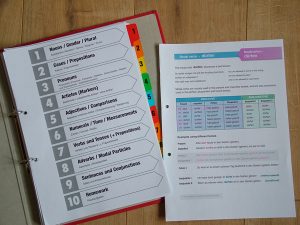
German is actually a beautiful and logical language if learnt with the knowledge of grammar behind it. In order to help students, I produce tailor-made grammar and exercise sheets and they find these most helpful. I encourage to keep a tabbed ringbinder to file the material for future reference.
For more variety and fun, we also explore other resources such as magazine articles, advertisements, online catalogues, travel websites, YouTube videos – anything that the student at intermediate or advanced level will be interested in, applying the language to the real world.
I have a great interest in ‘all things German’ – the culture and history, its geography and regions – and it’s good to build these topics into students’ work and give them a more in-depth knowledge of Germany.
To me, as a teacher, it is really rewarding to experience how a student will not only advance and make sense of the language, but start to enjoy it and develop a new sense of confidence.